Summary
Split has two virtual reality experiences related to Diocletian's Palace: Diocletian's Dream (a 15-minute seated VR film inside an indoor venue near the palace, €13) and Time Walk (an 80-minute guided walking tour through the actual palace with VR reconstructions at two key locations, €25). They are fundamentally different products at fundamentally different price points: Diocletian's Dream is a shorter, cheaper indoor film experience; Time Walk is a longer, more expensive guided walking tour with a licensed local guide. This comparison is written by Time Walk's founder. That is a deliberate choice, because a fair comparison between two competing businesses deserves a transparent author rather than a marketing copywriter pretending to be neutral.
Disclosure: I founded Time Walk. The comparison below uses publicly available information about Diocletian's Dream from their official website, GetYourGuide listing, and TripAdvisor reviews. Where Diocletian's Dream is the genuinely better choice for a particular kind of visitor, I say so directly.
Quick Facts: Time Walk vs Diocletian's Dream
Time Walk:
- Type: Outdoor walking tour with VR stops
- Duration: 80 minutes
- Price: €25
- Location: Inside Diocletian's Palace (starts at Gregory of Nin)
- Guide: Licensed Croatian tourist guide
- What you see: VR reconstructions at Golden Gate + Peristyle, plus walking tour of the palace
- Hardware: Meta Quest 3 (latest consumer VR headset)
- Group format: Small-group guided tours
- Walking required: Yes, a full palace walking tour
- Coverage: Golden Gate, Peristyle, Vestibule, Cathedral exterior, Cellars, Brass Gate
- Available: Group tours March to November; private tours all year
- Best for: Visitors who want to walk the actual palace with historical context
Diocletian's Dream:
- Type: Indoor VR film (seated)
- Duration: 15 minutes
- Price: €13
- Location: Indoor venue, Zagrebačka 1, Split
- Guide: No live guide (pre-recorded film)
- What you see: Pre-recorded VR film in fixed seated position
- Hardware: Standard VR headset (not specified)
- Group format: Group screenings every 30 minutes
- Walking required: No (seated experience)
- Coverage: Palace interiors (pre-recorded scenes)
- Available: Most of the year, with shorter winter hours (individual visits may pause from November to February)
- Best for: Visitors with mobility limitations, very short stops, indoor preference
The Short Answer
Diocletian's Dream is a 15-minute pre-recorded VR film you watch sitting inside an indoor venue near the palace. Time Walk is an 80-minute guided walking tour through the actual palace where you use VR at specific locations along the route.
Both reconstruct the palace as it appeared in 305 AD. Both use VR headsets. They are different products serving different visitors.
Choose Diocletian's Dream if:
- You have very limited time (less than 30 minutes)
- You have mobility limitations and prefer a seated experience
- You want only the VR visual, not a guided walking experience
- You prefer indoor experiences (rain, summer heat)
- Budget is the primary factor (€13 vs €25, nearly half the price)
Choose Time Walk if:
- You want to walk through the actual Roman palace
- You want a licensed local guide to provide live context
- You want the full historical experience, not just a film
- You want to try current VR technology (Meta Quest 3)
- You want depth over speed (80 minutes vs 15 minutes)
- You want the experience to be interactive and adapted to your group's questions
→ Book Time Walk for the walking tour. For the indoor film, visit Diocletian's Dream directly.
What Both Experiences Have in Common
Before the differences, the things both products share:
- Both reconstruct Diocletian's Palace as historians believe it looked in 305 AD, the year Emperor Diocletian moved into his retirement palace
- Both use VR technology to show visitors the original Roman complex
- Both are based in Split, Croatia
- Both are well-reviewed by visitors who chose them
- Both fill a real gap: most visitors to Diocletian's Palace struggle to picture what the original Roman building looked like under 1,700 years of medieval additions
- Both are legitimate businesses with online booking and TripAdvisor presence
Visitors sometimes confuse the two because both use VR + Diocletian's Palace as the core concept. They are not the same product.
What's Different: A Detailed Comparison
Format: Film vs Walking Tour
Diocletian's Dream is a film. You arrive at their indoor venue at Zagrebačka 1 (just outside the palace walls, near the Golden Gate). You sit down. You put on a VR headset. You watch a 15-minute pre-recorded experience. You take off the headset and leave.
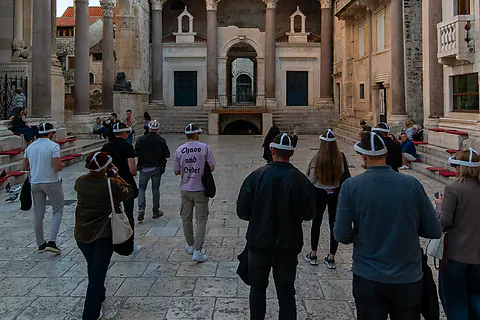
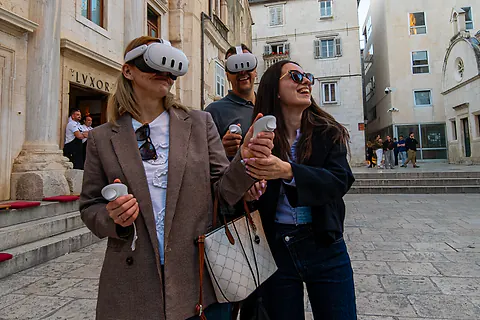
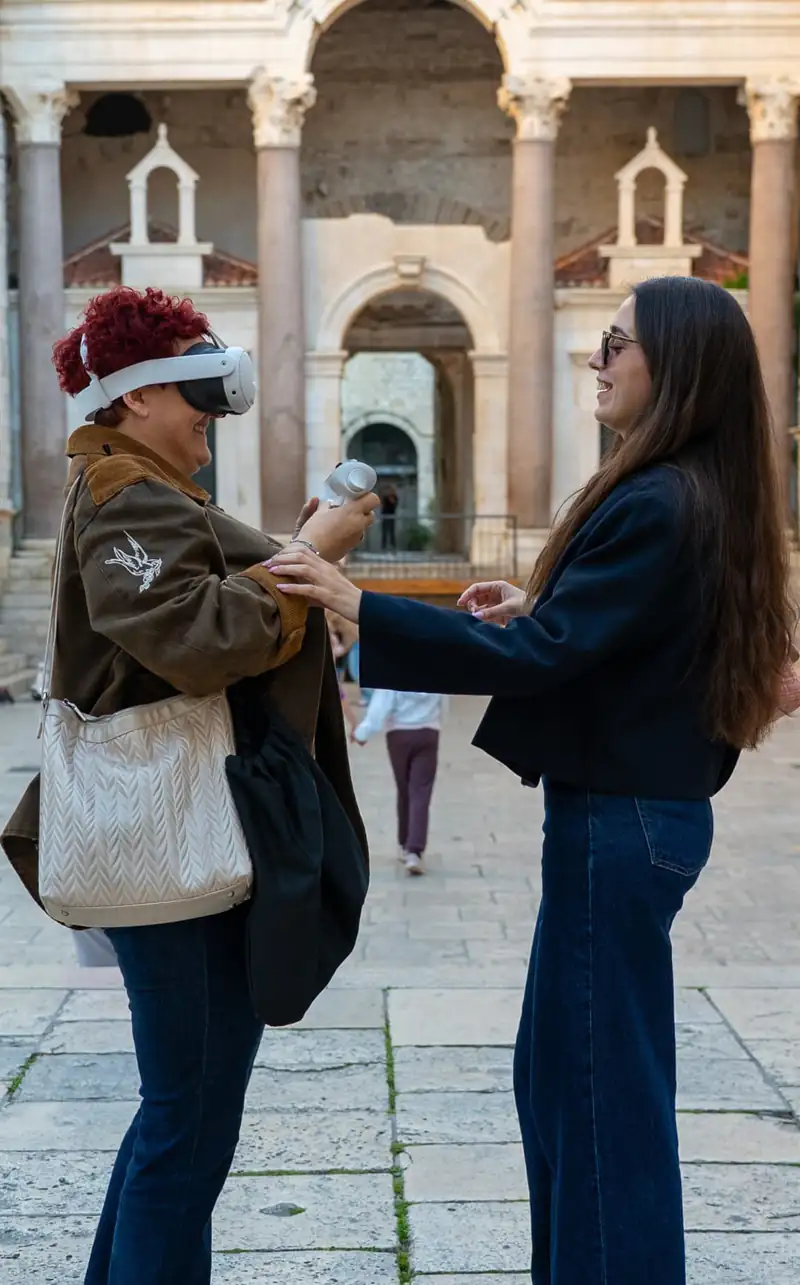
Time Walk is a walking tour. You meet your licensed guide at the Gregory of Nin just outside the Golden Gate. The group walks through the palace together: through the Golden Gate, the Vestibule, around the Cathedral exterior, down to the cellars, and out through the Brass Gate. At two specific stops (the Golden Gate and the Peristyle), you put on Meta Quest 3 headsets and see VR reconstructions overlaid on the actual Roman structures in front of you. Your guide provides historical context throughout the walking portions.
The experiential difference: Diocletian's Dream is passive consumption of pre-made content. Time Walk is active exploration of the real site with VR moments embedded.
Duration: 15 minutes vs 80 minutes
Diocletian's Dream: 15 minutes total. Screenings every 30 minutes.
Time Walk: 80 minutes total. Daily small-group tours.
For visitors with very limited time (cruise visitors with 3-4 hour stops, transit visitors), 15 minutes is a feature. For visitors with half a day or more, 15 minutes is significantly shorter than most other Split attractions.
Location: Indoor venue vs Inside the palace
Diocletian's Dream: Located at Zagrebačka ulica 1, in an indoor venue just outside the palace walls. You do not enter the palace as part of the experience.
Time Walk: Conducted inside the actual UNESCO World Heritage Site of Diocletian's Palace. You walk through the original Roman gates, stand in the Peristyle where Diocletian held audiences in 305 AD, and pass through the Vestibule where klapa singers perform today.
For visitors who specifically want to be inside the actual Roman palace while experiencing the reconstruction, Time Walk is, to our knowledge (checked November 2026), the only option that delivers this. Diocletian's Dream shows the palace on a screen; Time Walk shows the palace overlaid on the palace.
Guide: No guide vs Licensed local guide
Diocletian's Dream: Pre-recorded narration in eight languages (English, German, Italian, French, Croatian, Spanish, Portuguese and Polish), with staff on hand to fit the headsets. A new version of the film launched in April 2026. No live guide.
Time Walk: Led by a licensed Croatian tourist guide. The guide provides live context, answers questions, and adapts the explanation to the interests of each small group.
The practical difference: With a film, you get the same experience as everyone else. With a licensed guide, you get a live human who has spent years studying the site and can answer "what about that arch?" or "tell me more about Diocletian's wife" in real-time.
For visitors who already know Roman history well, the film may be sufficient. For visitors learning about the palace for the first time, a live guide significantly improves comprehension and retention.
Hardware: Standard VR vs Meta Quest 3
Diocletian's Dream: Uses VR headsets (specific model not publicly listed on their website).
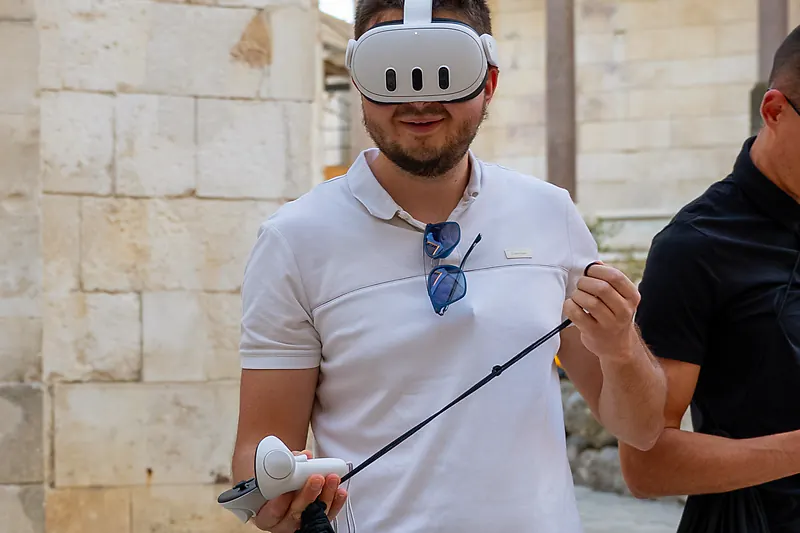
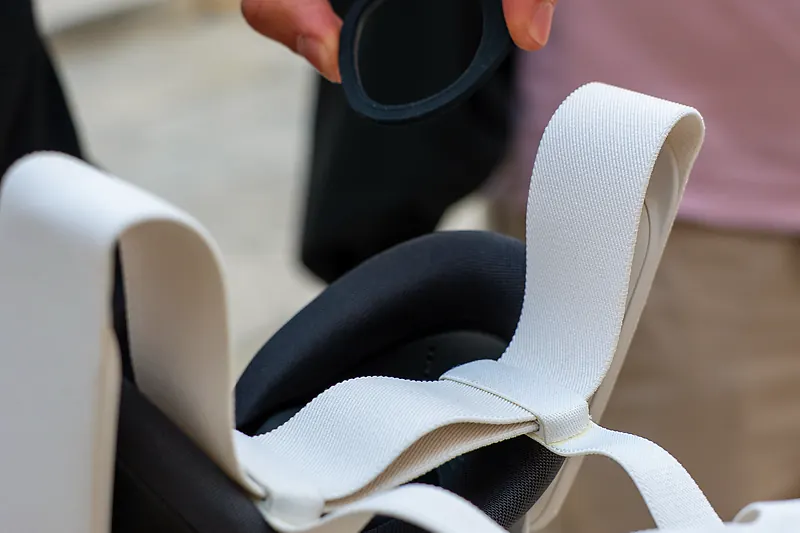
Time Walk: Uses Meta Quest 3 headsets, released in late 2023, with full-color passthrough cameras that allow you to see the real world overlaid with VR content.
I'll be specific about why this matters, because hardware decisions in VR are often glossed over. The Meta Quest 3's passthrough cameras are what allow Time Walk's "VR overlay on real palace" experience to work: you see the actual Roman gates in front of you with the reconstruction layered on top. Older VR headsets (Quest 2, Pico, Oculus Go) either don't have color passthrough at all or have very low-resolution passthrough that breaks the illusion. Diocletian's Dream's seated indoor format doesn't need passthrough technology, so their hardware choice is consistent with their design, but it also means their experience is locked into a film format, not an overlay format.
If you specifically care about using the latest VR technology, Time Walk has a clear hardware advantage. If you don't, hardware is largely irrelevant to your decision.
Price: €13 vs €25
Diocletian's Dream: €13 per adult, €9 per child aged 8 to 14. Children under 8 can't take part.
Time Walk: €25 per adult, €15 for ages 10 to 17. Children under 10 join the walk for free (without VR).
On absolute price, Diocletian's Dream is €12 cheaper, nearly half the price of Time Walk. For budget-focused visitors, this is a significant difference and a legitimate reason to choose Diocletian's Dream. I want to be clear about that up front.
On price-per-minute of experience, the comparison shifts:
- Diocletian's Dream: €13 ÷ 15 minutes = €0.87 per minute
- Time Walk: €25 ÷ 80 minutes = €0.31 per minute
Time Walk delivers approximately 2.8 times more experience per minute of spending.
This isn't a critique of Diocletian's Dream. Short experiences cost more per minute by nature, and Diocletian's Dream is well-executed for what it sets out to be. It is a fair value comparison for visitors deciding between the two. If your priority is duration and depth, Time Walk offers substantially more time per euro; if your priority is absolute cost, Diocletian's Dream is nearly half the price.
What You Actually See
Diocletian's Dream is a pre-recorded film that takes you through reconstructed palace interiors, royal chambers, and historical scenes from Diocletian's life. The film is the same for every screening.
Time Walk uses VR at two specific moments along the walking route:
- At the Golden Gate, VR reconstructs the original ceremonial north entrance with its painted statues, gilded archway, and approaching Roman road from Salona, as historians believe a dignitary arriving in 305 AD would have seen it
- At the Peristyle, VR reconstructs the central courtyard with the Temple of Jupiter, the imperial mausoleum, the colonnade with statues in their original niches, and the courtyard in active ceremonial use
The rest of the 80 minutes is spent walking through the palace on foot with the guide explaining the history of each site as you stand in it. This is closer to a traditional licensed walking tour than to a film experience.
Different visitors will prefer different formats. Film-style content has its strengths (consistent quality, dramatic narrative, viewable in 15 minutes). Walking-tour content has its strengths (you experience the actual physical site, live guide adapts to your interests, longer engagement). Neither is objectively better. They're different.
Which One Is Right for You?

Choose Diocletian's Dream if you...
- Have very limited time: 3-hour cruise stops, transit days, layovers
- Have mobility limitations or prefer not to walk
- Want an indoor experience (rainy day, extreme summer heat)
- Prefer film-style consumption over guided exploration
- Are budget-conscious and the €12 price difference matters (nearly half the price)
- Are not interested in the palace beyond the reconstruction: you want to see the visual, not walk the site
Choose Time Walk if you...
- Want to walk the actual Roman palace as part of the experience
- Want a licensed local guide who can answer questions live
- Have at least 1.5 hours to dedicate to the experience
- Value depth over speed: 5.3× longer than Diocletian's Dream and about 2.8 times cheaper per minute
- Want to see the reconstruction in a Meta Quest 3 headset on the spot
- Want a small-group experience rather than a group screening
- Are visiting the palace anyway and want one combined experience
Honestly: do both if you have time
For visitors with a full day in Split, doing both is genuinely defensible. They aren't competitors in the strict sense. They're complementary experiences of the same historical site.
A reasonable visitor itinerary:
- Morning: Time Walk for the walking tour + outdoor VR + historical narrative
- Afternoon: Diocletian's Dream for the indoor film + Diocletian's personal story content
Total cost: €38 per person. Total time: ~2 hours. Coverage: significantly more comprehensive than either alone.
What the Reviews Say
Diocletian's Dream is well rated on Tripadvisor and holds Tripadvisor's Travellers' Choice award for 2022 and 2023. Reviews praise the visual quality, the 15-minute format, and the historical content.
Time Walk is currently rated ★ 5.0 across 310+ reviews on Google and GetYourGuide. Reviews praise the licensed guide, the walking format, the small group size, and the Meta Quest 3 hardware.
Both have legitimate enthusiastic reviewers. The differences in review patterns reflect the different products: Diocletian's Dream reviewers tend to praise efficiency and visual impact; Time Walk reviewers tend to praise depth, the guide, and the combination of walking + VR.
My Honest Recommendation
I founded Time Walk and built the VR reconstruction system it runs on. Of course I think Time Walk is the better choice for most visitors, and I've explained above why I believe that based on hours per euro, hardware, format, and live guidance.
But the more relevant question is: why did I build Time Walk in a city that already had Diocletian's Dream?
Because I thought the existing VR offering missed what makes Diocletian's Palace genuinely extraordinary: that you can stand inside the actual Roman building while seeing it reconstructed in front of you. A film of the palace, however well produced, is fundamentally different from walking through the palace with a reconstruction overlaid on what's in front of you. I built Time Walk to do the second thing, because the technology (specifically Meta Quest 3's passthrough cameras) finally made it possible.
That said, Diocletian's Dream is a legitimate product that suits a real subset of visitors. Specifically: visitors with very short Split stops, with mobility limitations, or who simply prefer indoor seated film experiences. For those visitors, I'd genuinely recommend Diocletian's Dream over Time Walk. It is well-executed for what it sets out to be.
For everyone else (the majority of Split visitors with at least a half-day in the city), Time Walk delivers significantly more depth: a walking tour through the actual palace, a licensed guide, VR scenes on location, and a 5.3× longer experience that is about 2.8 times cheaper per minute. It is nearly twice the price, but it is also a fundamentally more substantial experience.
The honest answer depends on your specific situation. Both businesses exist because both formats meet real demand.
How to Book
Time Walk
- Price: €25 per person
- Duration: 80 minutes
- Group size: Small
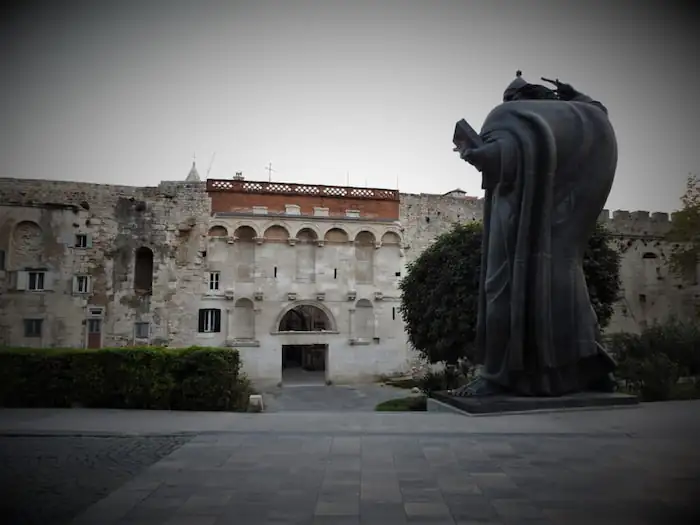
- Meeting point: Gregory of Nin, just outside the Golden Gate
- Available: Group tours daily from March to November; private tours all year
- Languages: English (other languages on request)
- Reviews: ★ 5.0 across 310+ reviews on Google and GetYourGuide
Diocletian's Dream
Book directly at diocletiansdream.com or via GetYourGuide and TripAdvisor.
- Price: €13 per person
- Duration: 15 minutes
- Format: Group screenings every 30 minutes
- Location: Zagrebačka ulica 1, Split (indoor venue, near Golden Gate)
- Available: Most of the year, shorter hours in winter
Frequently Asked Questions
What is the difference between Diocletian's Dream and Time Walk?
Diocletian's Dream is a 15-minute pre-recorded VR film you watch sitting indoors near the palace. Time Walk is an 80-minute guided walking tour through the actual palace with VR reconstructions at two specific stops along the route. They use similar technology to reconstruct the palace as it appeared in 305 AD, but they're fundamentally different formats: one is a film, the other is a walking tour with embedded VR moments.
Is Diocletian's Dream worth it?
For visitors with very limited time, mobility constraints, or who prefer indoor seated experiences, Diocletian's Dream offers a fast, efficient way to see a VR reconstruction of the palace. At 15 minutes and €13, it's the shorter and cheaper of Split's two VR options. Reviews are consistently positive from visitors who chose it. It is the right choice for a real subset of Split visitors, primarily those who don't have time for the longer walking tour or who can't physically do it.
Is Time Walk worth it?
For visitors with at least 90 minutes and an interest in walking through the actual Roman palace, Time Walk offers a substantially deeper experience: 80 minutes of guided walking + VR + licensed local guide for €25. It is 5.3× longer than Diocletian's Dream and about 2.8 times cheaper per minute, and is currently rated ★ 5.0 across 310+ reviews on Google and GetYourGuide. It is nearly double the price of Diocletian's Dream, but delivers a fundamentally different depth of experience. For most visitors with a half-day or longer in Split who want to actually understand what they're seeing, the additional cost is worth it.
Which is better, Diocletian's Dream or Time Walk?
Neither is objectively "better". They're different products at different price points serving different visitors. Diocletian's Dream is better for very short stops, mobility limitations, indoor preference, and tighter budgets (€13 vs €25, nearly half the price). Time Walk is better for visitors who want a full guided experience walking through the actual palace with substantially more depth. For most visitors with a half-day or more in Split, Time Walk delivers a 5.3× longer experience, about 2.8 times cheaper per minute, plus a licensed guide, though at nearly double the absolute cost. For visitors with under 30 minutes available or on tight budgets, Diocletian's Dream is the more practical choice.
Can I do both Diocletian's Dream and Time Walk?
Yes. They're complementary experiences and many visitors with a full day in Split do both. Total cost ~€38 per person, total time ~2 hours including walking between venues (both are within or immediately next to the palace). The combination gives you the indoor film + the outdoor walking tour for comprehensive coverage of the palace's history.
Do you need to know anything about Diocletian before either VR experience?
No. Both experiences are designed for visitors with no prior knowledge of Roman history or Diocletian. Time Walk's licensed guide provides full historical context throughout. Diocletian's Dream's pre-recorded narration covers the essentials. For visitors who want background reading before either experience, see our guide to Emperor Diocletian.
Are there other VR or AR experiences in Split?
As of June 2026, Diocletian's Dream and Time Walk are the two main VR experiences focused on Diocletian's Palace in Split. Several broader VR experiences exist in Croatia (Pula, Dubrovnik) but none are located inside Split's palace itself. For other walking tour formats (Game of Thrones–themed, food and wine, general overview), see our best walking tours in Split guide.
Which VR Split tour has better reviews?
Both have strong reviews. Diocletian's Dream is well rated on Tripadvisor and won Travellers' Choice in 2022 and 2023. Time Walk is currently rated ★ 5.0 across 310+ reviews on Google and GetYourGuide. The reviews reflect different audiences: Diocletian's Dream reviewers praise efficiency and visual quality; Time Walk reviewers praise the licensed guide, the walking format, and the depth of experience.
Which is better for cruise visitors with limited time?
For cruise visitors with only 3-4 hours in port, Diocletian's Dream's 15-minute format may be the more practical choice. For cruise visitors with 5+ hours in port, Time Walk's 80-minute walking tour fits comfortably and offers significantly more depth. For a complete breakdown of how to spend cruise stops in Split, see our cruise stop in Split guide.
Can I get a discount on either VR experience in Split?
Standard prices in 2026 are €13 (Diocletian's Dream) and €25 (Time Walk). Group discounts may be available for larger groups directly from either operator. Booking through third-party platforms (GetYourGuide, Viator) sometimes includes occasional promotional pricing but generally matches direct booking rates.