Summary
Cruise ships in Split dock in the City Port (Gradska luka), right beside the old town, so Diocletian's Palace is a 5 to 15 minute walk from most berths and you do not need a taxi or shuttle. Split is the second busiest cruise port in Croatia after Dubrovnik: 315 cruise ship calls in 2025, according to the Croatian Bureau of Statistics, with most of them between June and October. This guide, written by a licensed Croatian tourist guide who works daily with cruise visitors, covers where your ship docks, how to walk to Diocletian's Palace, when the port is busiest (with official month-by-month numbers), port facilities, how to plan your time based on port duration, whether ship-sponsored excursions are worth the price, and the most common mistakes cruise visitors make. Currency in Croatia is the Euro (adopted January 2023) and standard payment cards are accepted throughout Split.
Quick Facts About Split Cruise Port
- Where ships dock: the City Port of Split (Gradska luka), beside the old town
- Cruise berths: 10, from 150 to 265 metres long, plus an anchorage for tenders (Port of Split Authority)
- Walk to Diocletian's Palace: about 5 minutes from the inner berths, 10 to 15 minutes from the outer breakwater
- Currency: Euro (Croatia adopted the Euro in January 2023)
- Language: Croatian (English widely spoken in tourism sector)
- Time zone: Central European Time (CET/CEST, same as most of Europe)
- Cruise calls in 2025: 315, second in Croatia after Dubrovnik (Croatian Bureau of Statistics)
- Busiest months: June to October, with 37 to 48 calls a month in 2025
- Cruise passengers in 2025: 487,377 (Port of Split Authority)
- Payment: Cards widely accepted; small cash useful for taxis and market
The Short Answer
Cruise ships dock in Split's City Port, next to the old town. From most berths you walk to Diocletian's Palace in 5 to 15 minutes along the Riva promenade; no taxi or shuttle is needed. If your ship anchors, a tender brings you into the same harbour.
For visitors with 4-hour stops, focus on free areas of Diocletian's Palace plus one paid attraction. For 6-hour stops, add a guided walk such as Time Walk's Diocletian's Palace walking tour with VR (€25, 80 minutes, small groups) for historical context, or book Time Walk's private cruise tour, a private Split shore excursion, if you want a guide to meet your group at the ship (from €100 per group, €130 with VR). For 8+ hour stops, comfortably fit a guided tour plus every paid palace sight (€47: €25 for the tour, €16 for the five cathedral sites and €6 for the cellars). For detailed hour-by-hour activity itineraries once you're in the palace, see our cruise stop in Split guide.
Where Does Your Cruise Ship Dock in Split?
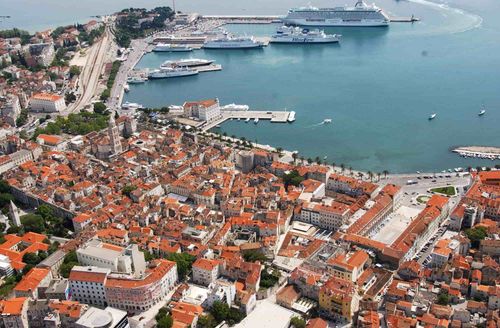
Cruise ships dock in Split's City Port (Gradska luka), the harbour right beside the old town. The Port of Split Authority lists 10 cruise berths, from 150 to 265 metres long, and an anchorage. It describes the old town inside Diocletian's Palace as "a short five-minute walk from the port".
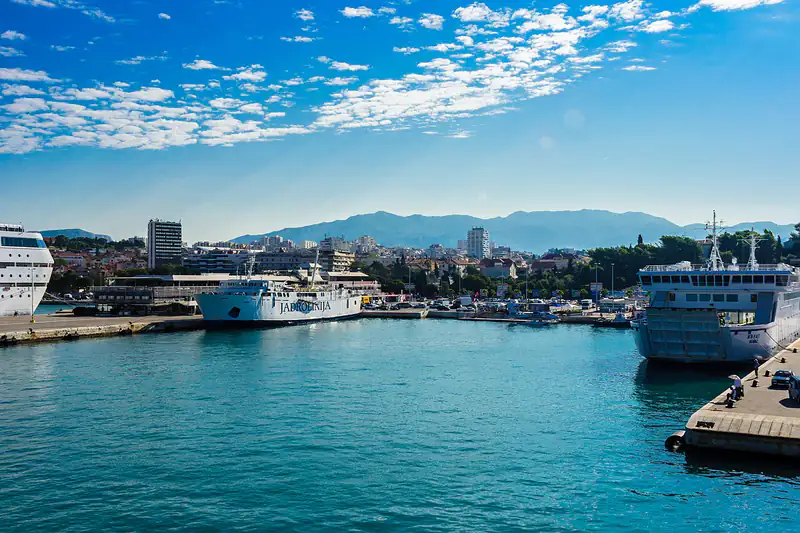
Berths in the City Port
Which berth you get depends on the size of your ship and how many ships are in port that day. From the berths closest to the Riva you can be at the palace's south wall in about five minutes. From the outer berths on the breakwater, allow about 10 to 15 minutes on foot. The walk is flat and follows the waterfront, but it has little shade, so carry water in summer.
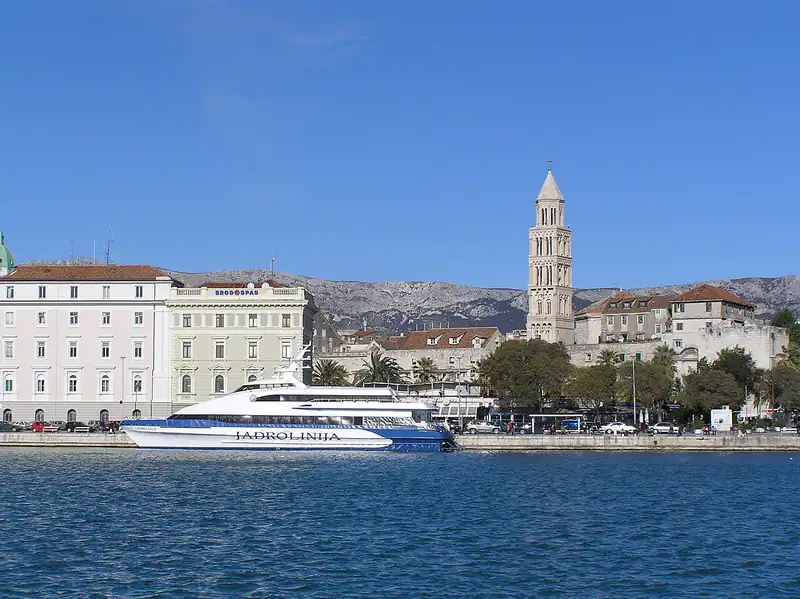
If your ship anchors and uses tenders
When the berths are full, a ship can anchor in the bay and bring passengers ashore by tender boat into the same harbour. Tendering adds time at both ends of the day, so note the time of the last tender back, not only the all-aboard time.
How to know where your ship will be
Your ship's daily program (delivered to your cabin the evening before) names the berth or says that you will tender. If unsure, ask at the ship's guest services desk. Cruise line apps usually confirm it about 24 hours before arrival.
Practical difference:
- Berth near the Riva: about 5 minutes on foot to the palace
- Outer berth on the breakwater: about 10 to 15 minutes on foot
- Tender: add the boat ride and any queue, at both ends of the day
Which Cruise Lines Visit Split
Split is a major stop on Adriatic and Eastern Mediterranean cruise itineraries. Major cruise lines with regular Split visits include:
- Large mainstream lines: MSC Cruises, Costa Cruises, Norwegian Cruise Line, Royal Caribbean, Celebrity Cruises, Princess Cruises, Holland America Line
- Premium lines: Viking Ocean Cruises, Oceania Cruises, Azamara
- Luxury/boutique lines: Silversea, Seabourn, Regent Seven Seas, Crystal Cruises
- Expedition/small-ship: Ponant, Sea Cloud Cruises, various small-ship operators
Specific ships and dates vary by season. For confirmed cruise schedules and expected ship traffic on your date, consult your cruise line's port information or specialised cruise port tracking websites.
When Split is busiest
Ships call in Split in every month of the year, but the season really runs from June to October. Official figures from the Croatian Bureau of Statistics show 315 cruise ship calls at the port of Split in 2025: between 37 and 48 a month from June to October, 17 in November and 7 in December. January to May together had 71 calls.

Show the numbers (DZS, 2025)
| Month | Cruise calls | Running total |
|---|---|---|
| January to May | 71 (about 14 a month) | 71 |
| June | 37 | 108 |
| July | 44 | 152 |
| August | 48 | 200 |
| September | 44 | 244 |
| October | 47 | 291 |
| November | 17 | 308 |
| December | 7 | 315 |
With 44 to 48 calls a month from July to October, Split averages around one and a half cruise ships a day at the height of the season, and on some days several large ships are in port at once. October is almost as busy as August, which surprises many visitors. Schedules change every year, so check a tracking site such as CruiseMapper or Cruise Timetables for your exact date.
For Croatia as a whole, the same DZS release counts 758 cruises by foreign ships in 2025, with 1,061,696 passengers on board. The Port of Split Authority counted 487,377 cruise passengers in Split itself in 2025.
Getting from the Port to Diocletian's Palace
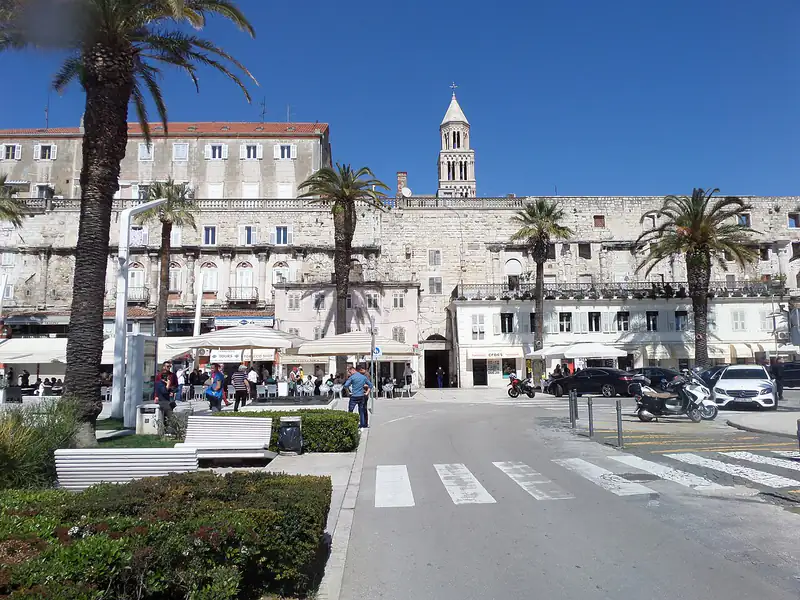
On foot (the usual way)
- Distance: roughly 500 metres to 1 km to the palace's Brass Gate, depending on the berth
- Time: about 5 to 15 minutes
- Route: along the harbour and the Riva promenade, flat and paved
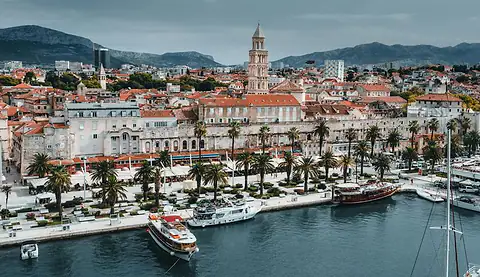
Follow the Riva west until you reach the Brass Gate, the small south entrance in the middle of the palace wall. It leads up through the cellars to the Peristyle. If you have booked Time Walk's group tour, the meeting point is the Gregory of Nin statue outside the Golden Gate, on the north side of the palace: walk straight through the palace from the Brass Gate and allow about five more minutes. Your guide holds a white umbrella.
Taxi or ride-hailing
Taxis wait on the Riva and near the ferry terminal, and Uber and Bolt also operate in Split. For the old town you rarely need one, because cars cannot drive into the palace streets anyway. A taxi makes sense if you have limited mobility, or if you are heading out of the centre to Bačvice, Marjan Hill, Klis or Salona.
Port Facilities and Services
Practical information for your time at the port and in Split.
Currency and payment
Croatia adopted the Euro in January 2023. Prior currency (Kuna) is no longer in use. Standard payment cards (Visa, Mastercard) are accepted at virtually all cruise-relevant businesses. American Express acceptance is more limited but growing. Small cash is useful for taxis, market shopping, and small vendors.
ATMs are widely available at the cruise terminal, throughout Split, and along the Riva. Most accept international cards. Choose ATMs from major Croatian banks (PBZ, Zagrebačka Banka, OTP, Erste), as these have transparent fees. Avoid Euronet and similar independent ATM operators, which charge significantly higher fees.
Currency exchange: No need to change money: Croatia is on the Euro. If you have leftover Kuna from a pre-2023 trip, exchange offices along the Riva can convert.
Language
Croatian is the official language, but English is widely spoken in Split's tourism sector. Every cruise-relevant service (taxis, restaurants, shops, tour operators) speaks functional English. German and Italian are also commonly spoken by older locals. Basic Croatian phrases are appreciated but not necessary.
Time zone
Split operates on Central European Time (CET/CEST), the same as most of continental Europe. Not a jurisdiction that keeps its clock separately.
WiFi and mobile data
Free WiFi is available at the cruise terminal, along the Riva, in most restaurants and cafés, and inside the palace. Free public WiFi hotspots operate in central Split. For heavy mobile data use, EU roaming applies for EU citizens; visitors from non-EU countries can purchase a Croatian SIM card at Tisak newsstands or mobile operator shops (A1, Hrvatski Telekom, Telemach), at a typical cost of ~€10–15 for a tourist data package.
Safety
Split is generally very safe for cruise visitors. Croatia has one of the lowest crime rates in Europe, and central Split (where cruise visitors spend their time) is a working urban centre with heavy foot traffic, active police presence, and low incidence of tourist-targeted crime.
Standard precautions apply: keep valuables secure in crowded areas (Peristyle at midday), be cautious of pickpocket opportunists on crowded buses, and don't leave items unattended. Emergency number in Croatia is 112 (European standard).
Restrooms
Public restrooms are limited in central Split. The cruise terminal has restrooms. On the Riva, some cafés and restaurants have restrooms available for customers. Public restrooms are located near the Pazar market (Silver Gate area) and at the western end of the Riva near the Bačvice beach. A small fee (€1) typically applies.
Luggage storage
If you have connecting luggage or want to explore Split before returning to your ship, luggage storage is available at:
- Split train and bus station (central, ~€3–5 per bag per day)
- Some cruise terminal service points on high-traffic days
- Private luggage services in central Split (search "luggage storage Split")
Most cruise visitors don't need luggage storage since they carry only day bags.
Restrooms on-shore during your day
Beyond the port, restroom availability is limited. Cafés and restaurants generally require purchase for restroom use. Plan bathroom stops around meal breaks or specific facilities. The Cathedral of Saint Domnius has restrooms for paying visitors.
Best Cruise Days to Visit Split
Not all cruise days in Split are equal. Some are significantly better than others based on ship traffic, weather, and season.
Multi-ship days vs single-ship days
On the busiest days, several large ships are in port at the same time. The Peristyle becomes dense, the bell tower queue gets long, and restaurants near the Riva fill up at lunchtime.

Single-ship days, more common in spring and late autumn, feel very different: manageable crowds, quicker service and better photography.
If your cruise itinerary offers date flexibility, choose Split port days with lower expected ship traffic. Websites like Cruise Timetables and CruiseMapper track expected daily ship arrivals.
Peak summer months (June–September)
- Heat: Daytime temperatures regularly exceed 32°C between 11 AM and 4 PM
- Crowds: Highest of the year
- Photography: Bright midday light is unflattering
- Recommendation: Explore the palace early morning (arrive as early as possible) and after 4:00 PM
Shoulder season (April–May, October)
- Weather: Ideal, warm enough to be pleasant, cool enough to be comfortable
- Crowds: Significantly reduced
- Amenities: All still open, but on reduced schedules
- Recommendation: These are the best months for a cruise stop in Split
Winter cruise stops (November–March)
- Weather: Cool, occasionally rainy
- Crowds: Minimal
- Amenities: Reduced hours, some attractions closed on specific days
- Recommendation: Atmospheric and quiet, but requires more careful attraction planning
What to Do Based on Your Port Duration
Split cruise stops typically range from 4 hours to 10+ hours. Your strategy should scale with your available time.
4-hour port stops (very short)
Feasible activities:
- Walk to the old town and back (20 to 40 minutes)
- An 80-minute guided walk, or free exploration of Diocletian's Palace (60 minutes)
- One high-value paid attraction: Temple of Jupiter (20 min) or the cathedral (30 min)
- Quick lunch or coffee
What's not realistic:
- Bell tower climb on a busy day (the queue eats your time)
- Several paid attractions plus a guided tour
- Any trip out of the centre
Budget: no transport needed; one interior ticket or a €25 group tour (single tickets €4 to €8, see our ticket guide)
6-hour port stops (typical)
Realistic activities:
- Walk to the old town and back (20 to 40 minutes)
- Free exploration of palace (30 min)
- A guided walk such as Time Walk's Diocletian's Palace walking tour with VR (€25, 80 min) with a licensed local guide and two Meta Quest 3 VR scenes
- One additional paid attraction (Temple of Jupiter or the cellars)
- Casual meal
Alternative without guided tour:
- Cathedral and bell tower on a combined ticket (90 min total including the queue)
- Temple of Jupiter (20 min)
- Free palace exploration
Budget: €25 for the tour plus one interior ticket (€4 to €8)
8-hour port stops (long)
Comfortable activities:
- Walk to the old town and back
- Guided walking tour with VR + full palace context
- All paid sights (the five cathedral sites and the cellars)
- Proper meal at a palace konoba (restaurant)
- Optional: brief walk on Marjan Hill or Bačvice beach
Total: Time Walk group tour €25 plus €22 in interior tickets (the Purple ticket for the five cathedral sites and the cellars): €47 for the complete Diocletian's Palace experience
Budget: the tour, the interior tickets and a sit-down meal
10+ hour port stops (extended)
For visitors with extended port days (some Croatia-focused itineraries or overnight port stops), consider adding:
- Day trip to Klis Fortress (25 min from Split, see our guide)
- Day trip to Salona (15 min from Split, see our guide)
- Longer Marjan Hill hike
- Bačvice beach afternoon
- Evening meal with wine
For complete hour-by-hour activity itineraries organized by port duration, see our detailed cruise stop in Split guide.
Cruise Ship Excursions vs Independent Exploration
Honest math from a licensed local guide.

Most cruise lines offer Split shore excursions ranging from €50 to €150+ per person, typically including transport from the ship, a guided walking tour of the palace, and sometimes attraction tickets.
What you get with a ship excursion:
- Convenient: walk off ship into a bus
- Guaranteed return to ship on time
- Guide (usually licensed, occasionally freelance)
- Insurance/backup: if the ship's excursion is late, the ship waits
What you don't get:
- Small group sizes (ship excursions typically 30–50 people)
- Choice of guide or tour style
- Depth (compressed schedule, minimal question time)
- Value: significant markup over independent booking
The math
Independent option:
- Walk from the ship to the old town: free
- Licensed guided walking tour such as the Time Walk group tour: €25
- Walk back to the ship: free
- Total: about €25 per person
Ship excursion equivalent:
- Typical Split palace excursion: €80–150 per person
- You pay several times more for the same core experience
The single legitimate reason to book through the ship is the "ship waits for its own excursions" policy, which gives genuine peace of mind for anxious travellers.
Recommendation for independent exploration
If you are happy to walk into town on your own and book a licensed local walking tour directly, you save money and usually get a better small-group experience. Groups of four or more can also book a private Split shore excursion, where a guide meets you at the ship. Time Walk's tours run in small groups instead of the 30–50 people of a ship excursion, meaning better acoustics in the narrow palace streets and actual conversation with your guide.
Practical safety: Be back at the port at least 30 minutes before your ship's all-aboard time. If you are tendering, allow extra time for the tender queue, which can be long when everyone returns at once.
Common Cruise Visitor Mistakes
Mistake 1: Booking the ship's excursion by default.
Convenience premium is real, but paying several times more for a palace walk you can reach on foot is significant. Independent visitors save meaningfully for the same core experience.
Mistake 2: Not starting early.
Ships typically dock 8:00–9:00 AM. The best palace experience is 7:00–10:00 AM: before crowds, before heat, best light. If you're still on the ship at 10:00 AM, you're competing with everyone else.
Mistake 3: Underestimating heat in July–August.
Split summer heat is genuine: the average daily high in July is 30°C and heatwaves go well above that, with the stone radiating heat back at you. The Riva has little shade at midday. Do the palace early, carry water and save the hottest hours for the cellars or a long lunch indoors.
Mistake 4: Trying to see everything in 4 hours.
Short port stops mean choosing depth or breadth. Depth, meaning one focused experience, is almost always more satisfying than rushing through 5 attractions.
Mistake 5: Not booking guided tours in advance.
Small-group tours like Time Walk fill quickly in peak season. Booking 24–48 hours ahead is minimum; morning of your port day is often too late.
Mistake 6: Skipping the cellars because "we saw the cellars on a ship excursion."
Ship excursions often visit only the free central corridor of the cellars, which is not the same as the developed exhibition sections. If you have 45 minutes, the paid cellars are worth it, as they are genuinely different from the free walkthrough.
Mistake 7: Ignoring the cathedral interior.
Cruise visitors often photograph the cathedral exterior and move on. The interior contains the only surviving contemporary portrait of Emperor Diocletian, the 1214 Buvina wooden doors, and the interior of Diocletian's original mausoleum. It's a genuine masterpiece.
Mistake 8: Missing return-to-ship time.
Ships depart on schedule. Independent visitors need to plan return transit with 30-minute buffer. Ship excursions include return transport by definition, which is one legitimate reason to book through the ship.
Peak Summer 2026 Specific Tips
Cruise visitors in July–August 2026 face specific challenges that shape strategy.
1. Early port arrival is critical. Ships that dock at 8:00 AM allow visitors to reach the palace by 9:00 AM, before midday heat and crowds. Ships arriving at 10:00 AM force visitors into the worst conditions.
2. Walk, don't queue. The old town is a short walk from the berths, so you can skip the taxi and shuttle lines entirely and be in the palace while others are still waiting.
3. Structure your day around heat. Palace exploration 9:00 AM–11:30 AM → indoor lunch 12:00–1:30 PM → cellars or bell tower 2:00–3:30 PM (paid attractions have some shade/cool air) → return to ship by 4:00–5:00 PM.
4. Reserve your Time Walk tour in advance. Peak season small-group tours fill 24–48 hours ahead. Booking morning of port day is often too late.
5. Bring water. Split summer is dehydrating. Free public water refill stations are limited in the historic centre. Carry water from the ship or a store.
6. Skip the bell tower if queue exceeds 30 minutes. In peak season midday, the bell tower queue can reach 45 minutes. The Temple of Jupiter (20 min, rarely a queue) is a better time investment.
7. Consider a day trip if extended. If your ship's schedule gives you 10+ hours, Klis Fortress or Salona as a half-day trip is an option. Both are dramatically less crowded than central Split in peak season.
Frequently Asked Questions
Where does the cruise ship dock in Split, Croatia?
Cruise ships dock in Split's City Port (Gradska luka), beside the old town. The Port of Split Authority lists 10 cruise berths and an anchorage; when the berths are full, ships anchor and bring passengers in by tender. Your ship's daily program or cruise line app confirms the berth about 24 hours before arrival.
How far is the Split cruise port from Diocletian's Palace?
Very close. From the berths nearest the Riva, Diocletian's Palace is about a five-minute walk; from the outer berths on the breakwater, about 10 to 15 minutes. The route is flat and follows the waterfront.
How much does a taxi cost from Split cruise port to old town?
Most cruise visitors don't need one: the old town is a short walk from the berths, and cars cannot drive into the palace streets. Taxis wait on the Riva, and Uber and Bolt also operate in Split, which is useful if you have limited mobility or are going further, for example to Bačvice beach or Klis.
Is there a shuttle bus from Split cruise port to town?
Usually you don't need one, because most berths are a 5 to 15 minute walk from the palace. If your ship runs a shuttle from an outer berth on a busy day, the daily program will say so.
Can I walk from Split cruise port to Diocletian's Palace?
Yes, and it is the easiest way. Walk along the harbour and the Riva promenade to the Brass Gate, the south entrance of the palace: about 5 minutes from the inner berths and 10 to 15 minutes from the outer breakwater. The route is flat and paved but has little shade in summer.
What time do cruise ships arrive in Split?
Most cruise ships arrive between 7:00 AM and 9:00 AM and depart between 4:00 PM and 7:00 PM. Specific arrival and departure times vary by ship. Check your ship's daily program for exact times and your all-aboard deadline (typically 30 minutes before departure).
Which cruise lines visit Split, Croatia?
Major cruise lines regularly visiting Split include MSC Cruises, Costa Cruises, Norwegian Cruise Line, Royal Caribbean, Celebrity Cruises, Princess Cruises, Holland America Line, Viking Ocean Cruises, Oceania Cruises, Silversea, Seabourn, Regent Seven Seas, and Ponant. Split appears on many Adriatic and Eastern Mediterranean itineraries as a mid-cruise port stop.
Is Split cruise port safe?
Yes, Split has one of the lowest crime rates in Europe, and central Split (where cruise visitors spend time) is a working urban centre with heavy foot traffic and active police presence. Standard precautions apply for tourists in any city: keep valuables secure in crowded areas, don't leave belongings unattended, and use metered taxis or official rideshare apps.
What currency is used at Split cruise port?
Croatia uses the Euro (adopted January 2023). Standard payment cards (Visa, Mastercard) are accepted at virtually all cruise-relevant businesses. ATMs are widely available at the terminal and throughout Split. If you have leftover Kuna from a pre-2023 trip, exchange offices along the Riva can convert.
Do I need a visa to visit Split on a cruise?
Visa requirements depend on your nationality. Croatia is part of the European Union and Schengen Zone (since January 2023). EU citizens and most Western Hemisphere visitors (US, Canada, UK, Australia, New Zealand, most Latin American nationalities) do not require a visa for tourist visits. Verify with your cruise line and consult the Croatian Ministry of Foreign Affairs for your specific nationality.
Do I need to book a Split cruise excursion in advance?
No, you don't need to book anything in advance. You can walk off the ship into the old town and explore Diocletian's Palace, buying tickets at the attraction ticket windows. For guided experiences such as Time Walk's Diocletian's Palace walking tour with VR (small groups, two VR scenes), booking 24 to 48 hours ahead is recommended in peak season. A private Split shore excursion is arranged by WhatsApp or email.
Are Split ship excursions worth it?
For most cruise visitors, ship-sponsored excursions are convenient but overpriced, typically €80–150 per person, while the palace is a short walk from the ship and a licensed group walking tour costs €25. The primary advantage of ship excursions is the "ship waits for its own excursions" policy, providing genuine peace of mind for visitors anxious about missing departure. For value-conscious visitors comfortable with independent transit, direct booking with local licensed operators offers better small-group experiences at 40–60% lower cost.
What's the best guided tour for cruise visitors in Split?
For most cruise visitors with 4+ hours in port, a small-group walking tour with a licensed local guide is the highest-value option. Time Walk (our own tour) offers an 80-minute walking tour with two Meta Quest 3 VR scenes of the palace as historians believe it looked in 305 AD, for €25, in small groups, rated ★ 5.0 from 310+ reviews on Google and GetYourGuide. If you want a guide just for your group, timed to your ship, there is a private Split shore excursion from €100 per group (€130 with VR). Traditional non-VR walking tours are also widely available.
Is there luggage storage at Split cruise port?
Yes, luggage storage is available at Split's main train and bus station in central Split (approximately €3–5 per bag per day), and at some private luggage services in the historic centre. Cruise terminals may also offer luggage storage on high-traffic days, though availability varies. Most cruise visitors don't need luggage storage since they carry only day bags.
How much cash should I bring for a Split cruise stop?
€30–60 in cash is comfortable for a typical cruise day: enough for a meal (~€20–30 mid-range), a coffee and small purchases. You can walk to the old town, and cards are widely accepted at attractions, restaurants and shops, so cash serves mainly for small vendors. ATMs are widely available if you need more.
When is Split cruise port busiest?
From June to October. In 2025 Split had 37 to 48 cruise ship calls a month in those five months, against 17 in November and 7 in December (Croatian Bureau of Statistics). During the day, the old town is busiest from about 10:00 AM to 3:00 PM, when passengers from several ships overlap. Starting early gives you the quietest palace.
Can I do a day trip from Split cruise port?
Yes, Split's location gives access to several excellent half-day trip destinations. Klis Fortress (25 min from Split) offers medieval Croatian history and Game of Thrones Meereen filming location. Salona (15 min) is where Emperor Diocletian was born, with substantial Roman ruins. For 10+ hour port stops, either combines well with palace exploration. For 4–8 hour stops, focus on Split itself. See our best day trips from Split guide for complete options.